

GRAPES of Ancient Mesopotamia


Testo Storyboard
- Diapositiva: 1
- What should we call this country?
- Mmmm... I think we should call it Mesopotamia because it means "the land between 2 rivers", and this country is between 2 rivers.
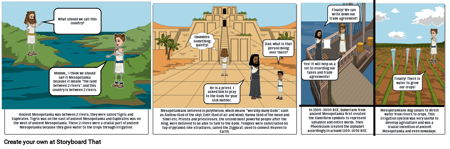
- Ancient Mesopotamia was between 2 rivers, they were called Tigris and Euphrates. Tigris was on the east of ancient Mesopotamia and Euphrates was on the west of ancient Mesopotamia. These 2 rivers were a crucial part of ancient Mesopotamia because they gave water to the crops through irrigation.
- Diapositiva: 2
- (mumbles something quietly)
- Dad, what is that person doing over there?
- He is a priest. I asked him to pray to the Gods for your sick mother.
- Mesopotamians believed in polytheism, which means "worship many Gods", such as An/Anu (God of the sky), Enlil (God of air and wind), Nanna (God of the moon and time) etc. Priests and priestesses, the second most powerful people after the king, were believed to be able to talk to the Gods. Temples were constructed on top of pyramid-like structures, called the Ziggurat, used to connect Heaven to Earth.
- Diapositiva: 3
- Finally! We can write down our trade agreement!
- Yes! It will help us a lot in recording our taxes and trade agreements!
- Finally! There is water to grow our crops!
- In 3500-3000 BCE, Sumerians from ancient Mesopotamia first created the Cuneiform symbols to represent syllables and entire words. Then Phoenicians created the alphabet accordingly in around 1100-1050 BCE.
- Mesopotamians dug canals to direct water from rivers to crops. This irrigation system was very useful to develop agriculture and was a crucial invention of ancient Mesopotamia and even nowadays.