

Unknown Story


Testo Storyboard
- My life sucks
- God gave me the divine right to rule over my filthy subjects!
- Reform!
- Give us better pay and cleaner factories!
- We just want to give this petition to our dear father, Nicholas II
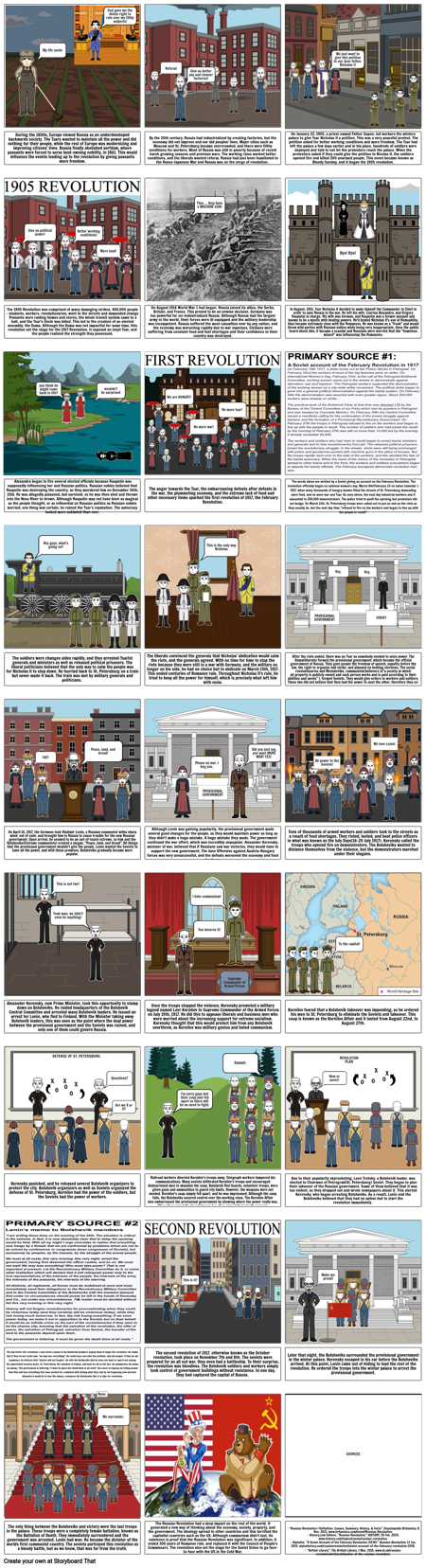
- During the 1800s, Europe viewed Russia as an underdeveloped backwards society. The Tsars wanted to maintain all the power and did nothing for their people, while the rest of Europe was modernizing and improving citizens' lives. Russia finally abolished serfdom, where peasants were forced to serve land-owning nobility, in 1861. This would influence the events leading up to the revolution by giving peasants more freedom.
- Give us political power!
- Better working conditions!
- More land!
- By the 20th century, Russia had industrialized by creating factories, but the economy did not improve and nor did peoples' lives. Major cities such as Moscow and St. Petersburg became overcrowded, and there were filthy conditions for workers. Most of Russia was still in poverty because of recent harsh growing seasons and previous wars. The working class wanted better conditions, and the liberals wanted reform. Russia had just been humiliated in the Russo-Japanese War and Russia was on the verge of revolution.
- They ... they have a MACHINE GUN!
- On January 22, 1905, a priest named Father Gapon, led workers the winters palace to give Tsar Nicholas II a petition. This was a very peaceful protest. The petition asked for better working conditions and more freedom. The Tsar had left the palace a few days earlier and in his place, hundreds of soldiers were deployed and told to not let the protesters reach the palace. When the protesters asked if they could give the petition to Nicolas II, the soldiers opened fire and killed 200 unarmed people. This event became known as Bloody Sunday, and it began the 1905 revolution.
- Bye! Bye!
- The 1905 Revolution was comprised of many damaging strikes. 400,000 people - students, workers, revolutionaries, went to the streets and demanded change Peasants were raiding homes and stores, the whole transit system came to a halt, and the Tsar's Uncle was killed. This led to the creation of an elected assembly, the Duma. Although the Duma was not impactful for some time, this revolution set the stage for the 1917 Revolution. It exposed an inept Tsar, and the people realized the strength they possessed.
- On August 1914 World War 1 had begun. Russia joined its allies, the Serbs, Britain, and France. This proved to be an unwise decision. Germany was too powerful for un-industrialized Russia. Although Russia had the largest army in the world, their forces were ill-equipped and the military leadership was incompetent. Russia suffered the most casualties ever by any nation, and the economy was worsening rapidly due to war expenses. Civilians were suffering from constant food and fuel shortages and their confidence in their country was destroyed.
- In August, 1915, Tsar Nicholas II decided to make himself the Commander in Chief in order to save Russia in the war. He left his wife, Czarina Alexandra, and Grigory Rasputin in charge. His wife was German, and Rasputin was a former peasant and known to be a mystic with healing powers. He'd healed Nicholas II's son of Hemophilia, thus became extremely close with the Romanovs. He was known as a "freak" and would throw wild parties with Russian nobles while being very inappropriate. Once the public heard about this, it became a scandal and Russians were worried that the "homeless wizard" was influencing the Romanovs.
- Alexandra began to fire several elected officials because Rasputin was supposedly influencing her and Russian politics. Russian nobles believed that Rasputin was destroying the country, so they murdered him on December 30th, 1916. He was allegedly poisoned, but survived, so he was then shot and thrown into the Neva River to drown. Although Rasputin may not have been as magical as the people thought, or as influential on Russian politics as Russian nobles worried, one thing was certain, he ruined the Tsar's reputation. The autocracy looked more outdated than ever.
- you think he might come back to life?
- wouldn't be surprised
- The anger towards the Tsar, the embarrassing defeats after defeats in the war, the plummeting economy, and the extreme lack of food and other necessary items sparked the first revolution of 1917, the February Revolution.
- We are HUNGRY!
- No more war!
- No more tsar!
- The words above are written by a Soviet giving an account on the February Revolution. The revolution officially began on national women's day, March 8th(February 23 on Julian Calendar ), 1917, when many thousands of hungry women filled the streets of St. Petersburg demanding more food, and no more war and Tsar. As seen above, the next day industrial workers and it amounted to 200,000 demonstrators. The police tried to quell the uprising but protesters did not budge. On March 11th, St. Petersburg troops were called out to put an end on the riots as they usually do, but the next day they "refused to fire on the workers and began to line up with the people in revolt".
- Hey guys, what's going on?
- This is the only way Nicholas
- PROVISIONAL GOVERNMENT
- Hey.
- Hey.
- SOVIET
- The soldiers were changes sides rapidly, and they arrested Tsarist generals and ministers as well as released political prisoners. The liberal politicians believed that the only way to calm the people was for Nicholas II to step down. He hurried back to St. Petersburg on a train but never made it back. The train was met by military generals and politicians.
- YAY!
- Peace, land, and bread!
- The liberals convinced the generals that Nicholas' abdication would calm the riots, and the generals agreed. With no time for time to stop the riots because they were still in a war with Germany, and the military no longer on his side, he had no choice but to abdicate on March 15th, 1917. This ended centuries of Romanov rule. Throughout Nicholas II's rule, he tried to keep all the power for himself, which is precisely what left him with none.
- Please no war. I beg you.
- Did you just say, you want MORE WAR! YES!
- After the riots ended, there was no Tsar so somebody needed to seize power. The Duma(liberals) formed the provisional government, which became the official government of Russia. They gave people the freedom of speech, equality before the law, the right to organize and strike, and planned on holding elections. The social revolutionaries and Mensheviks, communists(believers in"a society in which all property is publicly owned and each person works and is paid according to their abilities and needs" ), formed Soviets. They would give orders to workers and soldiers. These two did not believe that they had the power to oust the other, therefore they co-existed.
- All power to the Soviets!
- We love Lenin!
- On April 16, 1917, the Germans took Vladimir Lenin, a Russian communist witha sharp mind, out of exile, and brought him to Russia to cause trouble for the new Russian government. Upon arrival, he seemed to be an out-of-touch extreme, so him and the Bolsheviks(Extreme communists) created a slogan, "Peace, land, and bread". All things that the provisional government wouldn't give the people. Lenin wanted the Soviets to have all the power, and with these promises, Bolsheviks gradually became more popular.
- This is not fair!
- Although Lenin was gaining popularity, the provisional government made several good changes for the people, so they would maintain power as long as they didn't make a huge mistake. A huge mistake they made. The government continued the war effort, which was incredibly unpopular. Alexander Kerensky, minister of war, believed that if Russians saw war victories, they would have to support the new government. The June Offensive against Austria-Hungary forces was very unsuccessful, and the defeats worsened the economy and food shortages.
- I hate communism!
- PROVISIONAL GOVERNMENT
- Tens of thousands of armed workers and soldiers took to the streets as a result of food shortages. They rioted, looted, and beat police officers in what was known as the July Days(16-20 July 1917). Kerensky called the troops who opened fire on demonstrators. The Bolsheviks wanted to distance themselves from the violence, but the demonstrators marched under their slogans.
- Alexander Kerensky, now Prime Minister, took this opportunity to stamp down on Bolsheviks. He raided headquarters of the Bolshevik Central Committee and arrested many Bolshevik leaders. He issued an arrest for Lenin, who fled to Finland. With the Minister taking away Bolshevik leaders, this was seen as the point where the dual power between the provisional government and the Soviets was ruined, and only one of them could govern Russia.
- Yeah man, we didn't even do anything!
- Once the troops stopped the violence, Kerensky promoted a military legend named Lavr Kornilov to Supreme Commander of the Armed Forces on July 19th, 1917. He did this to appease liberals and business men who were worried about the increasing support for extreme socialism. Kerensky thought that this would protect him from any Bolshevik overthrow, as Kornilov was military genius and hated communism.
- You deserve it!
- Supreme Commander of Armed Forces
- Kornilov feared that a Bolshevik takeover was impending, so he ordered his men to St. Petersburg to eliminate the Soviets and takeover. This coup is known as the Kornilov Affair and it lasted from August 22nd, to August 27th.
- To the capital!
- DEFENSE OF ST. PETERSBURG
- x
- x
- o
- x
- o
- o
- Questions?
- Are we X or O?
- I'm sorry guys but their coup just fell apart so there will be no need to fight.
- Dammit.
- REVOLUTION PLAN
- Now or never!
- o
- x
- o
- x
- o
- x
- Kerensky panicked, and he released several Bolshevik organizers to protect the city. Bolshevik organizers as well as Soviets organized the defense of St. Petersburg. Kornilov had the power of the soldiers, but the Soviets had the power of workers.
- Railroad workers diverted Kornilov's troops away. Telegraph workers tampered his communications. Many soviets infiltrated Kornilov's troops and encouraged disheartened men to abandon the coup. Bolshevik Red Guards, volunteer troops, were given guns and ammunition to guard city limits. However, the weapons were not needed. Kornilov's coup simply fell apart, and he was imprisoned. Although the coup fails, the Bolsheviks secured control over the working class. The Kornilov Affair also embarrassed the provisional government by showing where the power really was. When they armed the Soviet troops too, they signed their death warrant.
- Due to their popularity skyrocketing, Leon Trotsky, a Bolshevik leader, was elected to Chairman of Petrograd(St. Petersburg) Soviet. They began to plan their takeover of the Russian government. Some of them believed that it was too violent, so they dropped out and wrote newspapers about it. This alerted Kerensky, who began arresting Bolsheviks. As a result, Lenin and the Bolsheviks believed that they had no option but to start the revolution immediately.
- Make me proud!
- The day before the revolution, Lenin wrote a memo to his Bolshevik members urging them to begin the revolution. He claims that if they do not revolt now, "we may lose everything". No conference can solve the problem, only the people. If they do not commence, he believes that "history will not forgive". He tells the Bolsheviks that he does not want to regret not seizing the opportunity because peace, St. Petersburg, the salvation of famine, and land are all on the line. He summarizes his memo by saying, "the government is tottering. It must be given the death blow at all costs". His sense of urgency by telling people that they will lose everything they have worked for, combined with stating what they risk by not beginning now and how shameful it would be to lose the chance, convinces the Bolsheviks that it is time for revolution.
- Nooo.
- The second revolution of 1917, otherwise known as the October revolution, took place on November 7th and 8th. The soviets were prepared for an all out war, they even had a battleship. To their surprise, the revolution was bloodless. The Bolshevik soldiers and workers simply took control of government buildings without resistance. In one day, they had captured the capital of Russia.
- This is it?
- Later that night, the Bolsheviks surrounded the provisional government in the winter palace. Kerensky escaped in his car before the Bolsheviks arrived. At this point, Lenin came out of hiding to lead the rest of the revolution. He ordered the troops into the winter palace to arrest the provisional government.
- SOURCES
- The only thing between the Bolsheviks and victory were the last troops in the palace. These troops were a completely female battalion, known as the Battalion of Death. They immediately surrendered and the government was arrested. Lenin had won. He became the dictator of the worlds first communist country. The soviets portrayed this revolution as a bloody battle, but as we know, that was far from the truth.
- We surrender.
- The Russian Revolution had a deep impact on the rest of the world. It generated a new way of thinking about the economy, society, property, and the government. The ideology spread to other countries and this terrified the capitalist countries such as the US. Although communism didn't last, its existence is proof that the Russian Revolution was significant. In addition, it ended 300 years of Romanov rule, and replaced it with the Council of People's Commissars. The revolution also set the stage for the Soviet Union to go face-to-face with the US in the Cold War.
- - - “Russian Revolution | Definition, Causes, Summary, History, & Facts.” Encyclopedia Britannica, 8 Nov. 2021, www.britannica.com/event/Russian-Revolution.- History.com Editors. “Russian Revolution.” HISTORY, 28 Feb. 2020, www.history.com/topics/russia/russian-revolution.- Alphahis. “A Soviet Account of the February Revolution (1938).” Russian Revolution, 13 Jan. 2019, alphahistory.com/russianrevolution/soviet-account-of-the-february-revolution-1938.- “British Library.” The British Library, 1 Mar. 2015, www.bl.uk/russian-revolution/articles/timeline-of-the-russian-revolution.