

Unknown Story


Testo Storyboard
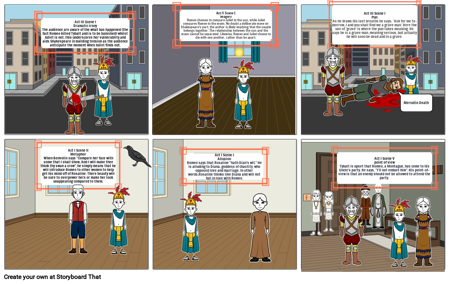
- Act III Scene IDramatic ironyThe audience are aware of the what has happened (the fact Romeo killed Tybalt and is to be banished) whilst Juliet is not, this underscores her vulnerablity and aids Shakespeare in building tension as the audience anticipate the moment when Juliet finds out.
- Act II Scene 1imageryRomeo chooses to compare Juliet to the sun, while Juliet compares Romeo to the moon. No doubt a deliberate move on Shakespeare's part, the author is likely implying that the couple belongs together. The relationship between the sun and the moon cannot be separated. Likewise, Romeo and Juliet choose to die with one another, rather than be apart.
- Act III Scene IPunAs he draws his last breaths he says: 'Ask for me to-morrow, / and you shall find me a grave man.' Here the use of 'grave' is where the pun takes meaning. He says he is a grave man, meaning serious, but actually he will soon be dead and in a grave.
- Mercutio Death
- Act I Scene IIMetaphor When Benvolio says "Compare her face with some that I shall show, And I will make thee think thy swan a crow", he simply means that he will introduce Romeo to other women to help get his mind off of Rosaline. There beauty will be sure to overpower hers or make her look unappealing compared to them.
- Act I Scene IAllusionRomeo says that Rosaline "hath Dian's wit." He is alluding to Diana, goddess of chastity, who opposed love and marriage. In other words,Rosaline thinks like Diana and will not fall in love with Romeo.
- Act I Scene Vpoint of viewTybalt is upset that Romeo, a Montague, has come to his Uncle's party. He says, "I'll not endure him". His point-of-view is that an enemy should not be allowed to attend the party.