

Unknown Story


Testo Storyboard
- Migration of Indo-Aryans to Indus Vally (1500 B.C.)
- Let's settle here!
- Blending of the language and culture
- ...
- ...
- The composing of Vedas
- I invented a language, Vedas!
- Vedas
- Nice Job!
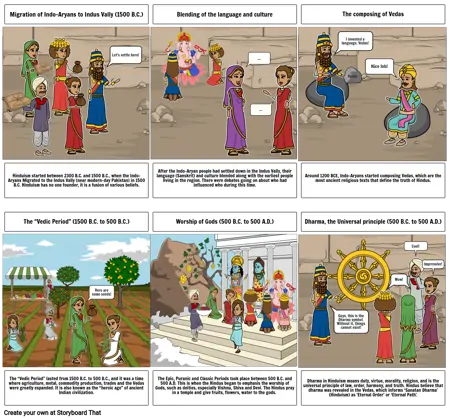
- Hinduism started between 2300 B.C. and 1500 B.C., when the Indo-Aryans Migrated to the Indus Vally (near modern-day Pakistan) in 1500 B.C. Hinduism has no one founder, it is a fusion of various beliefs.
- The “Vedic Period” (1500 B.C. to 500 B.C.)
- After the Indo-Aryan people had settled down in the Indus Vally, their language (Sanskrit) and culture blended along with the earliest people living in the region. There were debates going on about who had influenced who during this time.
- Worship of Gods (500 B.C. to 500 A.D.)
- Around 1200 BCE, Indo-Aryans started composing Vedas, which are the most ancient religious texts that define the truth of Hindus.
- Dharma, the Universal principle (500 B.C. to 500 A.D.)
- Cool!
- Impressive!
- The “Vedic Period” lasted from 1500 B.C. to 500 B.C., and it was a time where agriculture, metal, commodity production, trades and the Vedas were greatly expanded. It is also known as the “heroic age” of ancient Indian civilization.
- Here are some seeds!
- The Epic, Puranic and Classic Periods took place between 500 B.C. and 500 A.D. This is when the Hindus began to emphasis the worship of Gods, such as deities, especially Vishnu, Shiva and Devi. The Hindus pray in a temple and give fruits, flowers, water to the gods.
- Dharma in Hinduism means duty, virtue, morality, religion, and is the universal principle of law, order, harmony, and truth. Hindus believe that dharma was revealed in the Vedas, which informs ‘Sanatan Dharma’ (Hinduism) as 'Eternal Order’ or ‘Eternal Path’.
- Guys, this is the Dharma symbol. Without it, things cannot exist!
- Wow!