

Space science Meadow


Testo Storyboard
- Diapositiva: 1
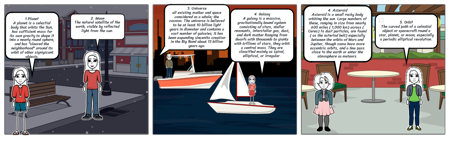
- 1.PlanetA planet is a celestial body that orbits the Sun, has sufficient mass for its own gravity to shape it into a nearly round sphere, and has cleared the neighborhood around its orbit of other signigicant objects.
- 2. MoonThe natural satellite of the earth, visible by reflected light from the sun.
- 3. Universeall existing matter and space considered as a whole; the cosmos. The universe is believed to be at least 10 billion light years in diameter and contains a vast number of galaxies; it has been expanding sincenits creation in the Big Band about 13 billion years ago.
- Diapositiva: 2
- 4. GalaxyA galaxy is a massive, gravitationally bound system consisting of stars, stellar remnants, interstellar gas, dust, and dark matter.Ranging from dwarfs with thousands to giants with trillions of stars, they orbit a central mass. They are classified mainly as spiral, elliptical, or irregular.
- Diapositiva: 3
- 4. AsteroidAsteroid is a small rocky body orbiting the sun. Large numbers of these, ranging in size from nearly 600 miles ( 1,000 km) across ( Ceres) to dust particles, are found ( as the asteriod belt) especially between the orbits of Mars and Jupiter, though some have more eccentric orbits, and a few pass close to the earth or enter the atmosphere as meteors.
- 5. OrbitThe curved path of a celestial object or spacecraft round a star, planet, or moon, especially a periodic elliptical revolution.
-