

Josephine Butler WS 2000


Testo Storyboard
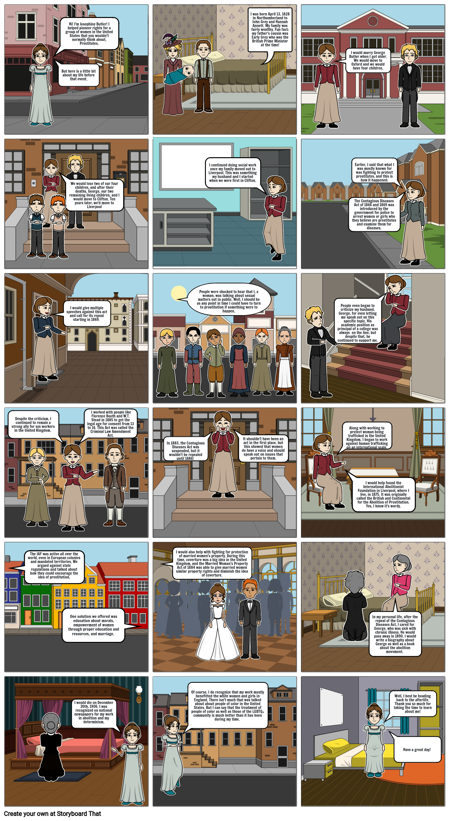
- Hi! I'm Josephine Butler! I helped pioneer rights for a group of women in the United States that you wouldn't normally think about. Prostitutes.
- But here is a little bit about my life before that event.
- I was born April 13, 1828 in Northumberland to John Grey and Hannah Annett. My family was fairly wealthy. Fun fact: my father's cousin was Early Grey who was the British Prime Minister at the time!
- I would marry George Butler when I got older. We would move to Oxford and we would have four children.
- We would lose two of our four children, and after their deaths, George, our two remaining living children, and I would move to Clifton. Ten years later, we'd move to Liverpool
- I continued doing social work once my family moved out to Liverpool. This was something my husband and I started when we were first in Clifton.
- The Contagious Diseases Act of 1866 and 1869 was introduced by the government for police to arrest women or girls who they believe are prostitutes and examine them for diseases.
- Earlier, I said that what I was mostly known for was fighting to protect prostitutes, and this is how it happened:
- I would give multiple speeches against this act and call for its repeal starting in 1869.
- People were shocked to hear that I, a woman, was talking about sexual matters out in public. Well, I should be as any point in time I could have to turn to prostitution if something were to happen.
- People even began to criticize my husband, George, for even letting me speak out on this specific topic. His academic position as principal of a college was always on the line, but despite that, he continued to support me.
- Despite the criticism, I continued to remain a strong ally for sex workers in the United Kingdom.
- I worked with people like Florence Booth and W.T. Stead in 1885 to get the legal age for consent from 13 to 16. This Act was called the Criminal Law Amendment Act.
- In 1883, the Contagious Diseases Act was suspended, but it wouldn’t be repealed until 1886!
- It shouldn’t have been an act in the first place, but this showed that women do have a voice and should speak out on issues that pertain to them.
- Along with working to protect woman being trafficked in the United Kingdom, I began to work against human trafficking on an international scale.
- I would help found the International Abolitionist Foundation in Liverpool, where I live, in 1875. It was originally called the British and Continental for the Abolition of Prostitution. Yes, I know it’s wordy.
- The IAF was active all over the world, even in European colonies and mandated territories. We argued against state regulations and talked about how they could encourage the idea of prostitution.
- One solution we offered was education about morals, empowerment of women through proper education and resources, and marriage.
- I would also help with fighting for protection of married women’s property. During this time, coverture was a big idea in the United Kingdom, and the Married Woman’s Property Act of 1884 was able to give married women similar property rights and diminish the idea of coverture.
- In my personal life, after the repeal of the Contagious Diseases Act, I cared for George, who was sick with chronic illness. He would pass away in 1890. I would write a biography about George as well as a book about the abolition movement.
- I would die on December 30th, 1906. I was recognized on national newspapers for my work in abolition and my determinism.
- Of course, I do recognize that my work mostly benefitted the white women and girls in England. There isn't much that was talked about about people of color in the United States. But I can say that the treatment of people of color as well as those of the LGBTQ+ community is much better than it has been during my time.
- Well, I best be heading back to the afterlife. Thank you so much for taking the time to learn about me!
- Have a great day!