

Untitled Storyboard


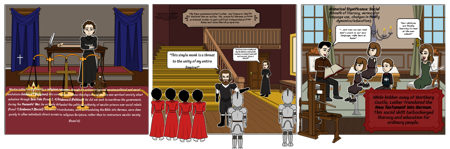
Montāžas Teksta
- Slidkalniņš: 1
- Martin Luther was primarily a religious reformer, though his actions triggered massive political and social revolutions.Evidence 1 (Religious): His core motivation was theological—solving his own spiritual anxiety about salvation through Sola Fide (Panel 2, 4).Evidence 2 (Political): He did not seek to overthrow the government; during the Peasants' War, he actively defended the political authority of secular princes over social rebels (Panel 7).Evidence 3 (Social): His social contributions, such as translating the Bible into German, were done purely to allow individuals direct access to religious Scripture, rather than to restructure secular society (Panel 6).
- Slidkalniņš: 2
- Historical Conenction: Political (German princes using the Reformation to challenge the Holy Roman Emperor and seize land wealth).
- The Pope excommunicated Luther, and Emperor Charles V declared him an outlaw. Yet, powerful German princes protected Luther to gain political independence from Rome and seize Church properties.
- "Unless I am convinced by Scripture and plain reason, I cannot and will not recant. Here I stand!"
- "This single monk is a threat to the unity of my entire Empire!"
- Slidkalniņš: 3
- Historical Significance: Social (Growth of literacy, vernacular language use, changes in family dynamics/education).
- "Our children are finally learning to read at the new school!"
- "...and now we can read God's word in our own language, right here at home"
- While hidden away at Wartburg Castle, Luther translated the New Testament into German. This social shift turbocharged literacy and education for ordinary people.