

Untitled Storyboard


Storyboard Tekst
- Lysbilde: 1
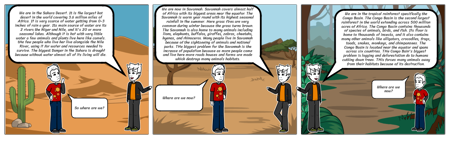
- We are in the Sahara Desert. It is the largest hot desert in the world covering 3.6 million miles of Africa. It is very scarce of water getting from 0-3 inches of rain a year. Its main source of water are its 2 rivers the Niger and Nile, and it's 20 or more seasonal lakes. Although it is hot with very little water a few animals and plants live here like camels. tHe few people who live her live alongside the Nile River, using it for water and resources needed to survive. The biggest Danger in the Sahara is drought because without water almost all of its living will die.
- So where are we?
- Lysbilde: 2
- We are now in Savannah. Savannah covers almost half of Africa with its biggest areas near the equator. The Savannah is warm year round with its highest seasonal rainfall in the summer. Here grass fires are very common during winter because the grass turns brown. The Savannah is also home to many animals including lions, elephants, buffalos, giraffes, zebras, cheetahs, hyenas, and rhinoceros. Many people live in Savannah because of the sightseeing of animals and national parks. THe biggest problem for the Savannah is the increase of population because as more people come and live here more roads houses and farms are made which destroys many animals habitats.
- Where are we now?
- Lysbilde: 3
- We are in the tropical rainforest specifically the Congo Basin. The Congo Basin is the second largest rainforest in the world extending across 500 million acres of Africa. The Congo Basin contains thousands of species of animals, birds, and fish. Its floor is home to thousands of insects, and it also contains many other animals like alligators, crocodiles, frogs, toads, snakes, monkeys, and chimpanzees. The Congo Basin is located near the equator and spans across six countries. THe Congo Bain's biggest problem is logging and deforestation do to humans cutting down trees. THis forces many animals away from their habitats because of its destruction.
- Where are we now?