

Untitled Storyboard


Storyboard Text
- Slide: 1
- Living – Something that is alive and shows all the characteristics of life.Nonliving – Something that is not alive and does not show the characteristics of life.Cells – The smallest unit of life; all living things are made of one or more cells.Organism – Any individual living thing.Growth – The process of Response to Stimuli – How living things react to changes in their environment.Stimulus (Stimuli) – A change in the environment that causes a response (light, temperature, sound).Homeostasis – The ability to maintain stable internal conditions (like body temperature).Adaptation – A trait that helps an organism survive in its environment.Cell – The smallest unit of life.Cell Theory – The idea that all living things are made of cells, cells are the basic unit of life, and all cells come from other cells.Unicellular – Made of only one cell.Multicellular – Made of many cells.Organelle – A structure inside a cell that has a specific job.Mitochondria – The “powerhouse” of the cell that releases energy from food.Ribosome – Makes proteins needed by the cell.Vacuole – Stores water, food, and waste materials.Endoplasmic Reticulum (ER) – Transports materials within the cell.Golgi Apparatus – Packages and sends proteins and other materials.Lysosome – Energy – The ability to do work or cause change.Cellular Respiration – The process cells use to release energy from food.ATP (Adenosine Triphosphate) – The main energy molecule of the cell.Mitochondria – The organelle where most cellular respiration happens; the “powerhouse” of the cell.GChloroplast – The organelle where photosynthesis occurs in plant cells.Sunlight – The energy source used in photosynthesis.Reactants – The starting materials in a chemical reaction.Products – The substances made during a chemical reaction.Chemical Reaction – A process where substances change into new substances.Aerobic – A process that requires oxygen.Anaerobic – A process that does not require oxygen.Fermentation – An anaerobic process cells use to release energy when oxygen is not available.Energy Cycle – How energy moves from the sun to plants to animals and through living things. lucose – A type of sugar that cells use as their main energy source.Oxygen – A gas needed for cellular respiration in most living things.Carbon Dioxide – A waste gas released during cellular respiration.Photosynthesis – The process plants use to make glucose using sunlight.Breaks down waste and old cell parts.Cell Wall – A rigid outer layer that provides support (found in plant cells).Chloroplast – Uses sunlight to make food through photosynthesis (found in plant cells).Prokaryotic Cell – A simple cell without a nucleus (bacteria).Eukaryotic Cell – A complex cell with a nucleus (plants, animals, fungi).Cell Membrane – The thin outer layer that controls what enters and leaves the cell.Cytoplasm – The jelly-like substance inside the cell where organelles are found.Nucleus – The control center of the cell that contains DNA.DNA – Genetic material that carries instructions for the cell.Environment – Everything around an organism that affects its survival.Heredity – The passing of traits from parents to offspring.DNA – The molecule that carries genetic information in living things.Life Cycle – The stages an organism goes through from birth to death.Movement – The ability of an organism or its parts to move. bigger or developing over time.Development – Changes an organism goes through during its life cycle.Reproduction – The ability to produce new organisms of the same kind.Energy – The fuel organisms need to grow, move, and carry out life processes.Metabolism – All the chemical reactions in an organism that keep it alive.
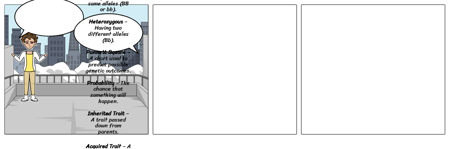
- Genetics – The study of how traits are passed from parents to offspring.Trait – A characteristic of an organism (eye color, height).Heredity – The passing of traits from parents to offspring.Gene – A section of DNARecessive – An allele that is masked by a dominant allele.Genotype – The genetic makeup of an organism (BB, Bb, bb).Phenotype – The physical appearance of a trait.Homozygous – Having two of the same alleles (BB or bb).Heterozygous – Having two different alleles (Bb).Punnett Square – A chart used to predict possible genetic outcomes.Probability – The chance that something will happen.Inherited Trait – A trait passed down from parents.Acquired Trait – A trait learned or developed during life. that controls a trait.DNA – The molecule that carries genetic information.Chromosome – A structure in the nucleus that contains DNA.Allele – Different forms of a gene.Dominant – An allele that masks another allele.