

Untitled Storyboard


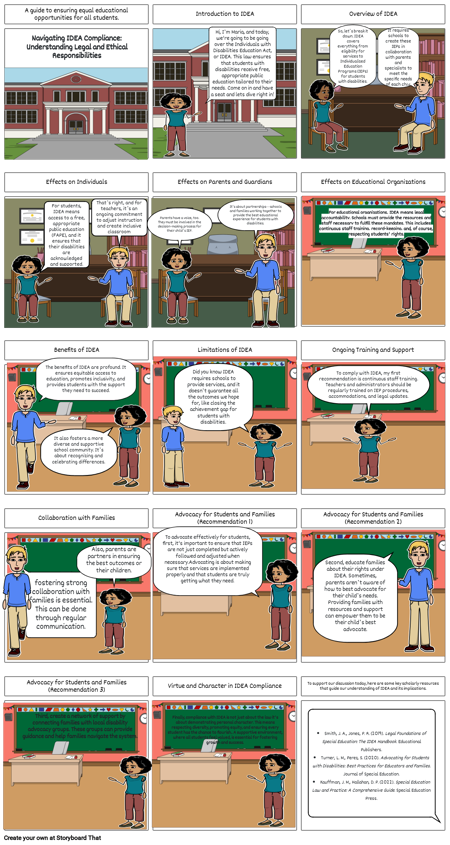
Storyboard Text
- Slide: 1
- A guide to ensuring equal educational opportunities for all students.
- Navigating IDEA Compliance: Understanding Legal and Ethical Responsibilities
- Slide: 2
- Introduction to IDEA
- Hi, I’m Maria, and today, we're going to be going over the Individuals with Disabilities Education Act, or IDEA. This law ensures that students with disabilities receive free, appropriate public education tailored to their needs. Come on in and have a seat and lets dive right in!
- Slide: 3
- Overview of IDEA
- So, let’s break it down. IDEA covers everything from eligibility for services to Individualized Education Programs (IEPs) for students with disabilities.
- It requires schools to create these IEPs in collaboration with parents and specialists to meet the specific needs of each child.
- Slide: 4
- Effects on Individuals
- That’s right, and for teachers, it’s an ongoing commitment to adjust instruction and create inclusive classroom
- For students, IDEA means access to a free, appropriate public education (FAPE), and it ensures that their disabilities are acknowledged and supported.
- Parents have a voice, too. They must be involved in the decision-making process for their child’s IEP.
- Slide: 5
- Effects on Parents and Guardians
- It’s about partnerships—schools and families working together to provide the best educational experience for students with disabilities.
- Slide: 6
- Effects on Educational Organizations
- For educational organizations, IDEA means legal accountability. Schools must provide the resources and staff necessary to fulfill these mandates. This includes continuous staff training, record-keeping, and, of course, respecting students' rights.
- Slide: 7
- Benefits of IDEA
- The benefits of IDEA are profound. It ensures equitable access to education, promotes inclusivity, and provides students with the support they need to succeed.
- It also fosters a more diverse and supportive school community. It’s about recognizing and celebrating differences.
- Slide: 8
- Limitations of IDEA
- Did you know IDEA requires schools to provide services, and it doesn’t guarantee all the outcomes we hope for, like closing the achievement gap for students with disabilities.
- Slide: 9
- Ongoing Training and Support
- To comply with IDEA, my first recommendation is continuous staff training. Teachers and administrators should be regularly trained on IEP procedures, accommodations, and legal updates.
- Slide: 10
- Collaboration with Families
- Also, parents are partners in ensuring the best outcomes or their children.
- fostering strong collaboration with families is essential. This can be done through regular communication.
- Slide: 11
- Advocacy for Students and Families (Recommendation 1)
- To advocate effectively for students, first, it's important to ensure that IEPs are not just completed but actively followed and adjusted when necessary.Advocating is about making sure that services are implemented properly and that students are truly getting what they need.
- Slide: 12
- Advocacy for Students and Families (Recommendation 2)
- Second, educate families about their rights under IDEA. Sometimes, parents aren’t aware of how to best advocate for their child’s needs. Providing families with resources and support can empower them to be their child’s best advocate.
- Slide: 13
- Advocacy for Students and Families (Recommendation 3)
- Third, create a network of support by connecting families with local disability advocacy groups. These groups can provide guidance and help families navigate the system.
- Slide: 14
- Virtue and Character in IDEA Compliance
- Finally, compliance with IDEA is not just about the law it’s about demonstrating personal character. This means respecting diversity, promoting equity, and ensuring every student has the chance to flourish.. A supportive environment, where all students feel valued, is essential for fostering growth and success.
- Slide: 15
- To support our discussion today, here are some key scholarly resources that guide our understanding of IDEA and its implications.
- Smith, J. A., Jones, P. R. (2019). Legal Foundations of Special Education: The IDEA Handbook. Educational Publishers.Turner, L. M., Perez, S. (2020). Advocating for Students with Disabilities: Best Practices for Educators and Families. Journal of Special Education.Kauffman, J. M., Hallahan, D. P. (2022). Special Education Law and Practice: A Comprehensive Guide. Special Education Press.