

IDEA STORYBOARD


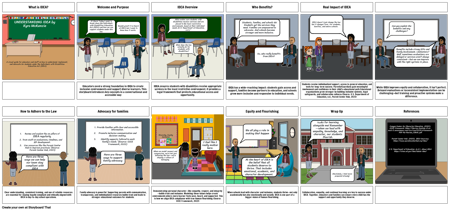
Storyboard Text
- Slide: 1
- What is IDEA?
- UNDERSTANDING IDEA by Kyra McKenzie
- A visual guide for educators and staff on how to understand, implement, and advocate for students under the Individuals with Disabilities Education Act (IDEA)
- Slide: 2
- Welcome and Purpose
- Hi there! Today I want to break down the Individuals with Disabilities Education Act (IDEA) and how we can support students under this law.
- Sounds great! I've heard of IDEA but I want to know how it works.
- Educators need a strong foundation in IDEA to create inclusive environments and support diverse learners. This storyboard introduces key concepts in a conversational and accessible way
- Slide: 3
- IDEA Overview
- IDEA makes sure students with disabilities receive services and are placed in the least restrictive environment, based on their individual needs (U.S. Department of Education, n.d.).”
- What does the law actually do for students with disabilities?
- IDEA ensures students with disabilities receive appropriate services in the least restrictive environment. It provides a legal framework that protects educational access and opportunity.
- Slide: 4
- Who Benefits?
- Students, families, and schools do! Students get the services they need. Families are empowered to advocate. And schools become stronger and more inclusive.
- So, who really benefits from IDEA?
- IDEA has a wide-reaching impact: students gain access and support, families become partners in education, and schools grow more inclusive and responsive to individual needs.
- Slide: 5
- Real Impact of IDEA
- IDEA doesn't just change the law but it changes lives. For students, families, and entire schools.
- Students receive individualized support, access to general education, and tools for long-term success. Parents/Guardians gain meaningful involvement and confidence in their child's educational path.Educational organizations grow stronger by building inclusive systems, legal safeguards, and collaborative cultures.(Source: U.S. Department of Education, n.d.; Parent Center Hub, 2023)
- Slide: 6
- How to Adhere to the Law
- Review and explain the six pillars of IDEA regularly.Train staff on evaluations, timelines, and IEP development.Use resources like the Parent Center Hub to improve practices.”(Source: Parent Center Hub, 2023)
- Here are three ways we can help our team stay compliant with IDEA
- Clear understanding, consistent training, and use of reliable resources are essential for staying legally compliant and ethically aligned with IDEA in day-to-day school operations.
- Slide: 7
- Advocacy for families
- Provide families with clear and accessible information.Promote inclusive communication and decision-making.Identify supports tailored to each family’s needs.”(Source: CCCE Framework, 2022)
- Here are three ways to support family advocacy
- Family advocacy is powerful. Supporting parents with communication, transparency, and individualized resources builds trust and leads to stronger educational outcomes for students.
- Slide: 8
- Diversity, Equity Inclusion
- I feel like I really matter here.
- When we model respect and compassion, we’re not just following the law—we’re shaping a culture of belonging.
- Demonstrating personal character—like empathy, respect, and integrity—builds trust and inclusion. Modeling these values helps create environments where every learner feels seen, heard, and supported. This is how we align IDEA compliance with true human flourishing.(Source: CCCE Framework, 2022)
- Slide: 9
- Equity and Flourishing
- We all play a role in making that happen
- At the heart of IDEA is the belief that all students deserve to thrive. That includes emotional, academic, and character development.
- When schools lead with character and inclusion, students thrive—not only academically but also emotionally and socially. IDEA is one part of a bigger vision of human flourishing.
- Slide: 10
- Wrap Up
- Thanks for learning alongside me! Remember—when we lead with empathy, knowledge, and character, our students flourish.
- Absolutely. I feel more prepared already!
- Collaboration, empathy, and continual learning are key to success under IDEA. Together, educators and families can ensure every child has the support and opportunity they deserve.
- Slide: 11
- Can you explain the benefits and any challenges?
- Benefits include strong IEPs and family involvement. Limitations? Well, sometimes evaluations are delayed or services aren’t always consistent—but we can improve with the right systems in place.
- While IDEA improves equity and collaboration, it isn’t perfect. Delayed evaluations or inconsistent implementation can be challenging—but training and proactive systems make a difference.
- Slide: 12
- References
- Canyon Center for Character Education. (2022). CCCE Framework. https://devrow-hosting.s3.us-east-2.amazonaws.com/ssc/coe/CCCE+Framework-PDF-Re-Review_FINAL.pdfParent Center Hub. (2023). IDEA Overview. https://www.parentcenterhub.org/idea/U.S. Department of Education. (n.d.). About IDEA. https://sites.ed.gov/idea/about-idea/