

Unknown Story


Storyboard Text
- Line 1When I have fears that I may cease to be
- Line 2Before my pen has glean'd my teeming brain,
- Poetic Device
- The rhyming pattern is ABABCDCDEFEFGG. It's divided into three different quatrains with a couplet at the end. The pattern goes like 'e' 'ry', 'ain' 'ain', 'ace' 'ace', 'ance' 'ance', 'our' 'ower', 'ore' 'ore', 'ink' 'ink'. With these words it makes the rhyming depend on the last syllable in each word.
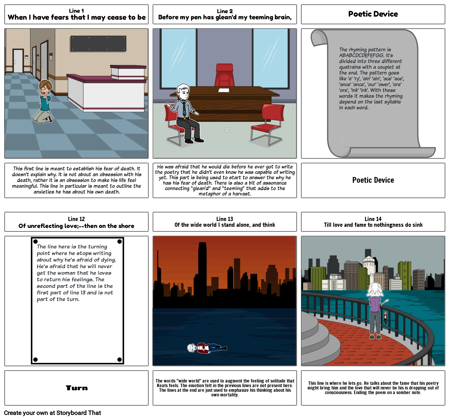
- This first line is meant to establish his fear of death. It doesn't explain why. It is not about an obsession with his death, rather it is an obsession to make his life feel meaningful. This line in particular is meant to outline the anxieties he has about his own death.
- Line 12Of unreflecting love;--then on the shore
- The line here is the turning point where he stops writing about why he's afraid of dying. He's afraid that he will never get the woman that he loves to return his feelings. The second part of the line is the first part of line 13 and is not part of the turn.
- He was afraid that he would die before he ever got to write the poetry that he didn't even know he was capable of writing yet. This part is being used to start to answer the why he has his fear of death. There is also a bit of assonance connecting "glean'd" and "teeming" that adds to the metaphor of a harvast.
- Line 13Of the wide world I stand alone, and think
- Poetic Device
- Line 14Till love and fame to nothingness do sink
- Turn
- The words "wide world" are used to augment the feeling of solitude that Keats feels. The emotion felt in the previous lines are not present here. The lines at the end are just used to emphasize his thinking about his own mortality.
- This line is where he lets go. He talks about the fame that his poetry might bring him and the love that will never be his is dropping out of consciousness. Ending the poem on a somber note.