

 Register as a teacher
AmStud


Storyboard Text
- Slide: 1
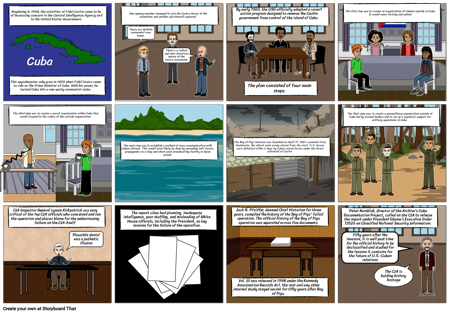
- Beginning in 1948, the activities of Fidel Castro came to be of increasing concern to the Central Intelligence Agency and to the United States Government.
- Cuba
- Slide: 2
- One agency member managed to join the Castro forces in the mountains and another got himself captured.
- There are definite communist over tones.
- Slide: 3
- By early 1960, the USG officially adopted a covert action program designed to remove the Castro government from control of the island of Cuba.
- The plan consisted of four main steps.
- Slide: 4
- The first step was to create an organization of Cubans outside of Cuba. It would seem inviting and united.
- Slide: 5
- This apprehension only grew in 1959 when Fidel Castro came to rule as the Prime Minister of Cuba. With his power, he turned Cuba into a one-party communist state.
- The third step was to create a secret organization within Cuba that would respond to the orders of the outside organization.
- Slide: 6
- The next step was to establish a method of mass communication with Cuban citizens. This would most likely be done by spreading anti-Castro propaganda via a long and short wave broadcasting facility in Swan Island.
- Slide: 7
- The Bay of Pigs invasion was launched on April 17, 1961. Launched from Guatemala, the attack went wrong almost from the start. U.S. forces were defeated within 2 days by Cuban armed forces under the direct command of Castro.
- Slide: 8
- The final step was to create a paramilitary organization outside of Cuba led by trained leaders and to set up a logistical support for military operations in Cuba.
- Slide: 9
- CIA Inspector General Lyman Kirkpatrick was very critical of the top CIA officials who conceived and ran the operation and places blame for the embarrassing failure on the CIA itself.
- Plausible denial was a pathetic illusion
- Slide: 10
- The report cites bad planning, inadequate intelligence, poor staffing, and misleading of White House officials, including the President, as key reasons for the failure of the operation.
- Slide: 11
- Jack B. Pfeiffer, deemed Chief Historian for three years, compiled the history of the Bay of Pigs' failed operation. The official history of the Bay of Pigs operation was separated across five documents.
- Vol. III was released in 1998 under the Kennedy Assasination Records Act, the rest and any other internal study stayed secret for fifty years after Bay of Pigs.
- Slide: 12
- Peter Kornbluh, director of the Archive’s Cuba Documentation Project, called on the CIA to release the report under President Obama’s Executive Order 13526 on Classified National Security Information.
- The CIA is holding history hostage
- Slide: 0
- There's a radical and anti-American nature of the Castro movement.
- Fifty years after the invasion, it is well past time for the official history to be declassified and studied for the lessons it contains for the future of U.S.-Cuban relations
Over 40 Million Storyboards Created
No Downloads, No Credit Card, and No Login Needed to Try!
