

Untitled Storyboard


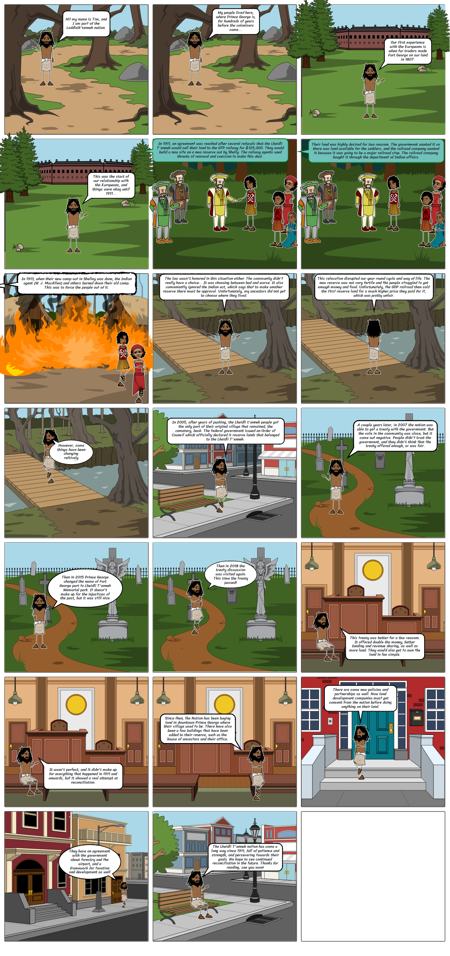
Storyboard Text
- Slide: 1
- Hi! my name is Tim, and I am part of the Leddleih'tennah nation.
- In 1911, an agreement was reached after several refusals that the Lheidli T'enneh would sell their land to the GTP railway for $125,000. They would build a new site on a new reserve out by Shelly. The railway agents used threats of removal and coercion to make this deal.
- Slide: 2
- My people lived here, where Prince George is, for hundreds of years before the colonizers came...
- Their land was highly desired for two reasons. The government wanted it so there was land available for the settlers, and the railroad company wanted it because it was going to be a major railroad stop. The railroad company bought it through the department of Indian affairs.
- Slide: 3
- Our first experience with the Europeans is when fur traders made Fort George on our land in 1807.
- Slide: 4
- This was the start of our relationship with the Europeans, and things were okay until 1911...
- In 1913, when their new camp out in Shelley was done, the Indian agent (W. J. MacAllen) and others burned down their old camp. This was to force the people out of it.
- The deal was hard to make, as the Lheidli T'enneh people were very attached to their land. In 1913, when their new camp out in Shelley was done, the Indian agent (W. J. MacAllen) and others burned down their old camp. This was to force the people out of it.
- Slide: 8
- The law wasn't honored in this situation either. The community didn't really have a choice... It was choosing between bad and worse. It also conveniently ignored the Indian act, which says that to make another reserve there must be approval. Unfortunately, my ancestors did not get to choose where they lived.
- Slide: 9
- This relocation disrupted our year round cycle and way of life. The new reserve was not very fertile and the people struggled to get enough money and food. Unfortunately, the GDP railroad then sold the first reserve land for a much higher price they paid for it, which was pretty unfair.
- Slide: 10
- However, some things have been changing reltively recently.
- Slide: 11
- In 2005, after years of pushing, the Lheidli t'enneh people got the only part of their original village that remained, the cemetery, back. The federal government issued an Order of Council which officially declared it reserve lands that belonged to the Lheidli T'enneh.
- Slide: 12
- A couple years later, in 2007 the nation was able to get a treaty with the government. But the vote in the community was close, but it came out negative. People didn't trust the government, and they didn't think that the treaty offered enough, or was fair.
- Slide: 13
- Then in 2015 Prince George changed the name of Fort George part to Lheidli T'enneh Memorial park. It doesn't make up for the injustices of the past, but it was still nice
- Slide: 14
- Then in 2018 the treaty discussion was visited again. This time the treaty passed!
- Slide: 15
- This treaty was better for a few reasons. It offered double the money, better funding and revenue sharing, as well as more land. They would also get to own the land in fee simple.
- Slide: 16
- It wasn't perfect, and it didn't make up for everything that happened in 1911 and onwards, but it showed a real attempt at reconciliation.
- Slide: 17
- Since then, the Nation has been buying land in downtown Prince George where their village used to be. There have also been a few buildings that have been added to their reserve, such as the house of ancestors and their office.
- Slide: 18
- There are some new policies and partnerships as well. Now land development companies must get consent from the nation before doing anything on their land.
- Slide: 19
- They have an agreement with the government about forestry and the airport, and a framework for taxation and development as well
- Slide: 20
- The Lheidli T'enneh nation has come a long way since 1911, full of patience and strength, and persevering towards their goals. We hope to see continued reconciliation in the future. Thanks for reading, see you soon!