

Sex Gender and Power


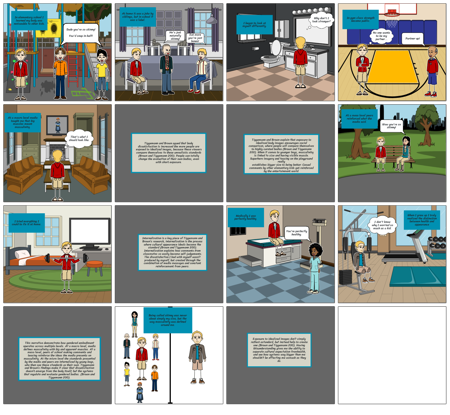
Storyboard Text
- Slide: 1
- In elementary school I learned my body was noticeable to other kids.
- Dude you're so skinny!You'd snap in half!
- Slide: 2
- At home it was a joke by siblings, but in school it was a label.
- He's just naturally skinny!
- Eat more you're just bones!
- Slide: 3
- Why don't I look stronger?
- I began to look at myself differently.
- Slide: 4
- In gym class strength became public.
- No one wants to be my partner...
- Partner up!
- Slide: 5
- At a macro level media taught me that big muscles meant masculinity.
- That's what I should look like.
- Slide: 6
- Tiggemann and Brown agued that body dissatisfaction is increased the more people are exposed to idealized images, because these viewers compare themselves to these unrealistic standards (Brown and Tiggemann 200). People can totally change the evaluation of their own bodies, even with short exposure.
- Slide: 7
- Tiggemann and Brown explain that exposure to idealized body images encourages social comparison, where people will compare themselves to highly curated bodies (Brown and Tiggemann 200). When it comes to younger boys, masculinity is linked to size and having visible muscle. Superhero imagery and teasing on the playground really establishes bigger size to being better. Casual comments by other elementary kids get reinforced by the entertainment world.
- Slide: 8
- At a meso level peers reinforced what the media said.
- Wow you're so skinny!
- Slide: 9
- I tried everything I could to fix it at home.
- Slide: 10
- Internalization is a key piece of Tiggemann and Brown’s research, internalization is the process where cultural appearance ideals become the standard (Brown and Tiggemann 200). Internalization explains how comments from classmates so easily become self-judgements. The dissatisfaction I had with myself wasn’t produced by myself, but created through the combination of media messages and constant reinforcement from peers.
- Slide: 11
- Medically I was perfectly healthy.
- You're perfectly healthy.
- Slide: 12
- When I grew up I truly realized the distinction between health and appearance
- I don't know why I worried so much as a kid.
- Slide: 13
- This narrative demonstrate how gendered embodiment operates across multiple levels. At a macro level, media defines masculinity with big and apparent muscles. At a meso level, peers at school making comments and teasing reinforce the ideas the media presents on masculinity. At the micro level the standards presented by the media and peers are internalized by young boys, who then see these standards as their own. Tiggemann and Brown’s findings make it clear that dissatisfaction doesn’t emerge from the body itself, but the systems that regulate and evaluate gendered bodies. (Brown and Tiggemann 200).
- Slide: 14
- Being called skinny was never about simply my size, but the way masculinity was defined around me.
- Slide: 15
- Exposure to idealized images don’t simply reflect astandard, but instead help to create one (Brown and Tiggemann 200). Having thisunderstanding gives me the ability to separate cultural expectation fromhealth, and see how systems way bigger than me shouldn’t be effecting me asmuch as they do.