

physci pt


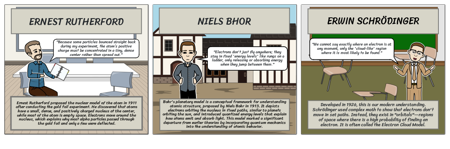
Storyboard Text
- Slide: 1
- ERNEST RUTHERFORD
- "Because some particles bounced straight back during my experiment, the atom’s positive charge must be concentrated in a tiny, dense center rather than spread out."
- Ernest Rutherford proposed the nuclear model of the atom in 1911 after conducting the gold foil experiment. He discovered that atoms have a small, dense, and positively charged nucleus at the center, while most of the atom is empty space. Electrons move around the nucleus, which explains why most alpha particles passed through the gold foil and only a few were deflected.
- Slide: 2
- NIELS BHOR
- "Electrons don't just fly anywhere; they stay in fixed 'energy levels' like rungs on a ladder, only releasing or absorbing energy when they jump between them."
- Bohr's planetary model is a conceptual framework for understanding atomic structure, proposed by Niels Bohr in 1913. It depicts electrons orbiting the nucleus in fixed paths, similar to planets orbiting the sun, and introduced quantized energy levels that explain how atoms emit and absorb light. This model marked a significant departure from earlier theories by incorporating quantum mechanics into the understanding of atomic behavior.
- Slide: 3
- ERWIN SCHRÖDINGER
- "We cannot say exactly where an electron is at any moment, only the 'cloud-like' region where it is most likely to be found."
- Developed in 1926, this is our modern understanding. Schrödinger used complex math to show that electrons don't move in set paths. Instead, they exist in "orbitals"—regions of space where there is a high probability of finding an electron. It is often called the Electron Cloud Model.