

Untitled Storyboard


Storyboard Text
- Slide: 1
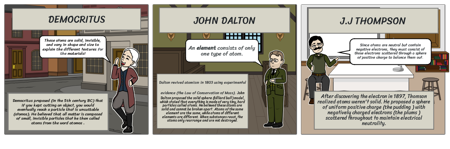
- DEMOCRITUS
- These atoms are solid, invisible, and vary in shape and size to explain the different textures for the materials!
- Democritus proposed (in the 5th century BC) that if you kept cutting an object, you would eventually reach a particle that is uncuttable (atomos). He believed that all matter is composed of small, invisible particles that he then called atoms from the word atomos .
- Slide: 2
- JOHN DALTON
- An element consists of only one type of atom.
- Dalton revived atomism in 1803 using experimental evidence (the Law of Conservation of Mass). John Dalton proposed the solid sphere (billiard ball) model, which stated that everything is made of very tiny, hard particles called atoms. He believed these atoms are solid and cannot be broken apart. Atoms of the same element are the same, while atoms of different elements are different. When substances react, the atoms only rearrange and are not destroyed.
- Slide: 3
- J.J THOMPSON
- Since atoms are neutral but contain negative electrons, they must consist of those electrons scattered through a sphere of positive charge to balance them out.
- After discovering the electron in 1897, Thomson realized atoms weren't solid. He proposed a sphere of uniform positive charge (the pudding ) with negatively charged electrons (the plums ) scattered throughout to maintain electrical neutrality.