

גאוגרפיה של סין העתיקה


Storyboard Description
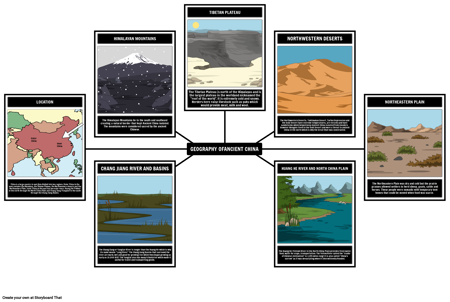
ענבים: גיאוגרפיה, דת, הישגים, פוליטיקה, כלכלה וחיים חברתיים. לוח סיפור זה מסביר את המאפיינים הגיאוגרפיים של סין העתיקה.
Storyboard Text
- Slide: 1
- TIBETAN PLATEAU
- The Tibetan Plateau is north of the Himalayas and is the largest plateau in the worldand nicknamed the "roof of the world". It is extremely cold and snowy. Herders here raise livestock such as yaks which would provide meat, milk and wool.
- Slide: 2
- NORTHWESTERN DESERTS
- The Northwestern Deserts: Taklimakan Desert, Turfan Depression and the Gobi Desert have extreme temperatures, are very dry and have sandstorms which helped keep Ancient China isolated from invaders. However Mongols lived in the Gobi Desert and were a threat to ancient China in the north which is why the Great Wall was constructed.
- Slide: 3
- NORTHEASTERN PLAIN
- The Northeastern Plain was dry and cold but the prairie grasses allowed settlers to herd sheep, goats, cattle and horses. These people were nomadic with temporary tent homes that could be moved when food was scarce.
- Slide: 4
- HUANG HE RIVER AND NORTH CHINA PLAIN
- The Huang He (Yellow) River in the North China Plain provides fresh water, food, water for crops, transportation. The Yellow River called the "cradle of Chinese civilization" is 3,395 miles long! It is also called "China's sorrow" as it was devastating when it intermittently flooded.
- Slide: 5
- CHANG JIANG RIVER AND BASINS
- The Chang Jiang or Yangtze River is longer than the Huang He which is why its name means "Long River." The Chang Jiang Basins that surround the river are warm, wet and good for growing rice which they began growing as early as 10,000 BCE! The Yangtze also has many tributaries which made it useful for travel and transporting goods.
- Slide: 6
- LOCATION
- OuterChina
- InnerChina
- China is a large country in east Asia divided into two regions: Outer China to the west contains the Himalayas, the Tibetan Plateau, the Northwestern deserts and the Northeastern Plain. Inner China to the east has two main rivers: Huang He (Yellow) in the north through the North China Plain and Chang Jiang (Yangtze) in the south through the Chang Jiang Basins.
- Slide: 7
- HIMALAYAN MOUNTAINS
- The Himalayan Mountains lie to the south and southeast creating a natural border that kept Ancient China isolated. The mountains were considered sacred by the ancient Chinese.