

Forms of Government - Kenley Chambers


Storyboard Text
- Slide: 1
- Israel - Democratic Parliamentary
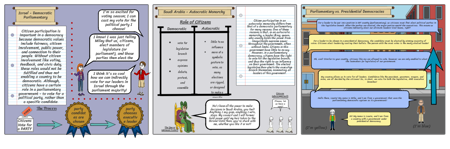
- Citizen participation is important in a democracy because democratic values include fairness, citizen involvement, public power, and connection to their people. Without citizen involvement like voting, feedback, and civic duty, these roles would not be fulfilled and thus not enabling a country to be democratic. Although, citizens have a certain role in a parliamentary government - to vote for a political party, rather than a specific candidate.
- I think it's so cool how we can indirectly vote for our leaders in Israel through the parliament majority!
- The Process
- party candidates are chosen
- party chooses executive leader
- Citizens Vote for a PARTY
- Citizens Vote
- Slide: 2
- Role of Citizens
- Citizen participation in an autocratic monarchy differs from that of a democratic parliamentary for many reasons. One of these reasons is that, in an autocratic monarchy, a leader (king; queen, who usually holds the power from linage) holds supreme power throughout the government, often without limits. Citizens in this government have little to no say. However, in a parliamentary democracy, citizens have the right to vote for the legislative branch, and thus the right to an influence on their government. The elected legislative then elects the executive branch themselves, nominating all leaders of this government.
- Saudi Arabia - Autocratic Monarchy
- Autocratic
- Democratic
- vote for legislative branchexpress opinionsdebate, protest, and assemble against political ideas or governments
- little to no influence more of a symbolic gesture to vote, as many elections are rigged, or designed to make a specific candidate winfreedoms are often strictly enforced, or very limited
- Citizens (often oppressed)
- Please, let us have a say!?
- Ha! I have all the power to make decisions in Saudi Arabia, you fool! Anything I say goes, anything I veto, stops. My council and I will forever hold power until my heir takes to the throne! Until then, you're stuck with me, whether you like it or not!
- The Queen(ultimate leader)
- Slide: 3
- Parliamentary vs. Presidential Democracies
- For a leader to be put into position in MY country (parliamentary), us citizens must first elect political parties in the legislative branch. After the parties are elected, the major parties anoint the executives. This means us citizens indirectly elect our ultimate leaders! Cool beans, right?
- For a leader to be chosen in a presidential democracy, the candidate must be elected by winning majority of votes. Citizens elect leaders by casting their ballots. The person with the most votes is the newly elected leader!
- Oh, cool! Similar to your country, citizens like me are allowed to vote, however; we are only enabled to elect the lawmakers (or legislator) of our government.
- My country allows us to vote for all leaders. Candidates like the president, governors, mayors, and more, are all decided by the citizens! So, in short, we vote for both the legislative, AND executive branches!
- Read from top to bottom
- (I'm blue)
- (I'm yellow)
- Hi! My name is Laurie, and I am from a country with a government under presidential democracy.
- Slide: 0
- vote
- I'm so excited for voting season; I can cast my vote for the political party I choose!
- I know! I was just telling Miley that us, citizens, elect members of legislature (or parliament), and those parties then elect the executives!
- Hello there, Laurie! My name is Mike, and I am from a government that uses the parliamentary democratic system as its government!