

Agriculture and Its Impact on Local Watersheds


Storyboard Text
- Lilly Minacci
- Impacts of Agriculture on Local Watersheds
-
-
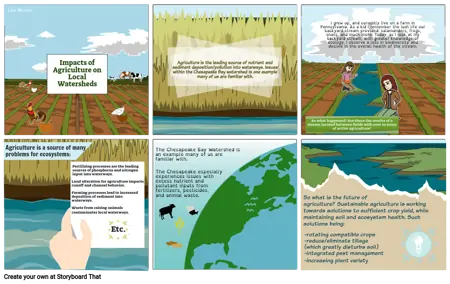
- With an exponentially increasing population, and land surface remaining the same, issues stemmed from increased agriculture are felt across the globe. Freshwater sources such as streams and ponds feel the greatest impacts of agriculture.
- So what happened? Are these the results of a stream located between fields with over 20 years of active agriculture?
- I grew up, and currently live on a farm in Pennsylvania. As a kid I remember the lush life our backyard stream provided: salamanders, frogs, snails, and much more. Today, as I look at my backyard stream, with greater knowledge of ecology, I observe a loss in biodiversity and decline in the overall health of the stream.
- Agriculture is a source of many problems for ecosystems:
-
- Land alteration for agriculture impacts runoff and channel behavior.
- Farming processes lead to increased deposition of sediment into waterways.
- Waste from raising animals contaminates local waterways.
- Fertilizing processes are the leading sources of phosphorus and nitrogen input into waterways.
-
- Etc.
- The Chesapeake Bay Watershed is an example many of us are familiar with.
- The Chesapeake especially experiences issues with excess nutrient and pollutant inputs from fertilizers, pesticides, and animal waste.
-
- So what is the future of agriculture? Sustainable agriculture is working towards solutions to sufficient crop yield, while maintaining soil and ecosystem health. Such solutions being:
- -rotating compatible crops-reduce/eliminate tillage (which greatly disturbs soil)-integrated pest management-increasing plant variety
-
-
-