

Unknown Story


Storyboard Text
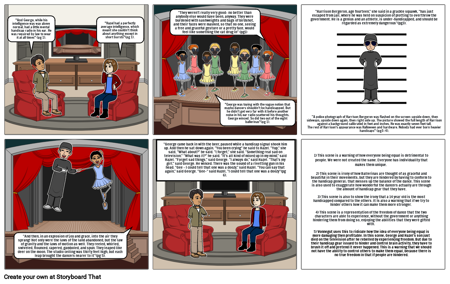
-  "And George, while his intelligence was way above normal, had a little mental handicap radio in his ear. He was required by law to wear it at all times" (pg 1).
- "Hazel had a perfectly average intelligence, which meant she couldn't think about anything except in short bursts"(pg 1).
- "They weren't really very good- no better than anybody else would have been, anyway. They were burdened with sashweights and bags of birdshot, and their faces were masked, so that no one, seeing a free and graceful gesture or a pretty face, would feel like something the cat drug in" (pg1)
- "George was toying with the vague notion that maybe dancers shouldn't be handicapped. But he didn't get very far with it before another noise in his ear radio scattered his thoughts.George winced. So did two out of the eight ballerinas"(pg 1).
-  "A police photograph of Harrison Bergeron was flashed on the screen-upside down, then sideways, upside down again, then right side up. The picture showed the full length of Harrison against a background calibrated in feet and inches. He was exactly seven feet tall.The rest of Harrison's appearance was Halloween and hardware. Nobody had ever born heavier handicaps" (pg3-4).
- "Harrison Bergeron, age fourteen," she said in a grackle squawk, "has just escaped from jail, where he was held on suspicion of plotting to overthrow the government. He is a genius and an athlete, is under-handicapped, and should be regarded as extremely dangerous"(pg3).
- "And then, in an explosion of joy and grace, into the air they sprang! Not only were the laws of the land abandoned, but the law of gravity and the laws of motion as well. They reeled, whirled, swiveled, flounced, capered, gamboled, and spun. They leaped like deer on the moon. The studio ceiling was thirty feet high, but each leap brought the dancers nearer to it"(pg 5).
- "George came back in with the beer, paused while a handicap signal shook him up. And then he sat down again. "You been crying" he said to Hazel. "Yup," she said. "What about?" he said. "I forget," she said. "Something real sad on television." "What was it?" he said. "It's all kind of mixed up in my mind," said Hazel. "Forget sad things," said George. "I always do," said Hazel. "That's my girl," said George. He winced. There was the sound of a rivetting gun in his head. "Gee - I could tell that one was a doozy," said Hazel. "You can say that again," said George. "Gee-" said Hazel, "I could tell that one was a doozy"(pg 6). 
- 1) This scene is a warning of how everyone being equal is detrimental to people. We were not created the same. Everyone has individuality that makes them unique. 2) This scene is irony of how Ballerinas are thought of as graceful and beautiful in their movements, but they are hindered by having to conform to the handicap general; that messes up the balance of the dance. This scene is also used to exaggerate how wonderful the dancers actually are through the amount of handicap gear that they have.3) This scene is also to show the irony that a 14 year old is the most handicapped compared to the others. It Is also a warning that if we try to hinder others how it can make them more stronger. 4) This scene is a representation of the freedom of dance that the two characters are able to experience, without the government or anything hindering them from doing so, enjoying the abilities that they were gifted with. 5) Vonnegut uses this to ridicule how the idea of everyone being equal is more damaging then profitable. In this scene, George and Hazel's son just died on the television after he rebelled by experiencing freedom. But due to their handicap gear issued to hinder and control brain activity, they have to brush it off and pretend it never happened. This is a warning that we should not have the ability to control others to make them equal, because there is no true freedom in that if people are hindered.