

7 Wonders of The World pt3


Storyboard Text
- Slide: 1
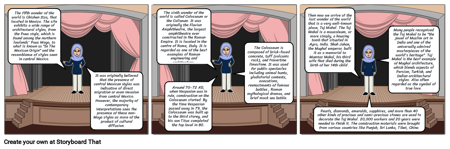
- The fifth wonder of the world is Chichen Itza, that located in Mexico. The site exhibits a wide range of architectural styles, from the Puuc style, which is found among the northern lowlands' Puuc Maya, to what is known as "In The Mexican Origin" and the resemblance of styles seen in central Mexico.
- It was originally believed that the presence of central Mexican styles was indicative of direct migration or even invasion from central Mexico. However, the majority of contemporary interpretations sees the presence of these non-Maya styles as more of the product of cultural diffusion.
- Slide: 2
- The sixth wonder of the world is called Colosseum or the Coliseum. It was originally the Flavian Amphitheatre, the largest amphitheatre ever constructed in the Roman Empire. It is located in the centre of Rome, Italy. It is regarded as one of the best examples of Roman engineering and architecture.
- The Colosseum is composed of brick-faced concrete, tuff (volcanic rock), and travertine limestone. It was used for public spectacles including animal hunts, gladiatorial contests, executions, reenactments of famous battles , Roman mythological dramas, and brief mock sea battle.
- Around 70–72 AD, when Vespasian was in rule, construction on the Colosseum started. By the time Vespasian passed away in 79, the Colosseum was built up to the third storey, and his son Titus completed the top level in 80.
- Slide: 3
- Then now we arrive at the last wonder of the world that is a very well-known place, Taj Mahal. The Taj Mahal is a mausoleum, or more simply, a housing tomb that situated in Agra, India. Shah Jahan, the Mughal emperor, built it as a memorial to Mumtaz Mahal, his third wife that died during the birth of her 14th child .
- Many people recognised the Taj Mahal to be "the jewel of Muslim art in India and one of the universally admired masterpieces of the world's heritage". Taj Mahal is the best example of Mughal architecture, which blends aspects of Persian, Turkish, and Indian architectural styles. Also often regarded as the symbol of true love.
- Slide: 0
- Pearls, diamonds, emeralds, sapphires, and more than 40 other kinds of precious and semi-precious stones are used to decorate the Taj Mahal. 20,000 workers and 20 years were needed to finish it. The construction materials were brought from various countries like Punjab, Sri Lanka, Tibet, China.